3.jpg)
Published May 13, 2025
Over-Edited Listing Photos: Is There Such a Thing? By Realtor.com

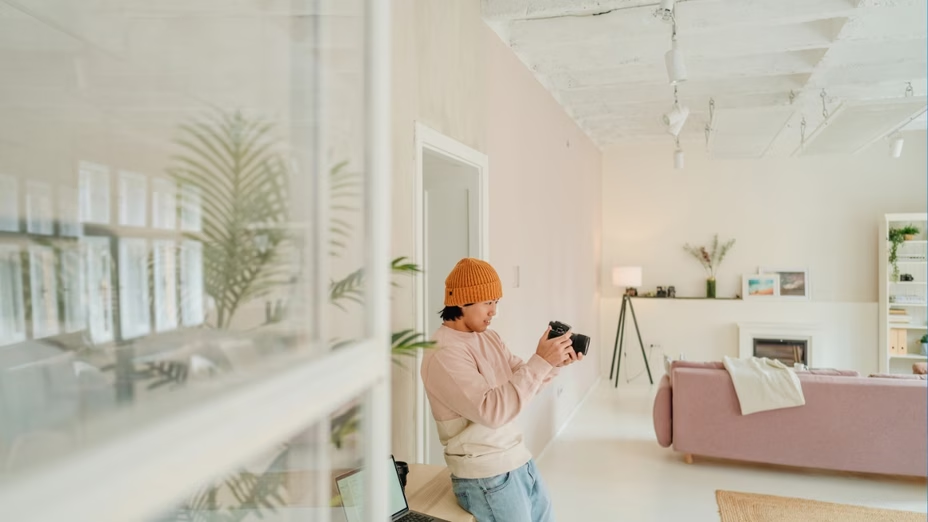
My husband and I had only been shopping for homes for only a few days, but as I swiped through photos from a new listing, I was certain our search had come to an end. This house was perfect.
The property was in a great area, had a perfect amount of bedrooms and bathrooms, plus a dreamy interior. I drooled over photos of big, bright rooms dressed up with hip furniture. I emailed my agent: We needed to tour it ASAP.
But when we got to the home, I almost didn't recognize it. The interior photos had clearly been edited, and in real life, the rooms were dark, dirty, and much smaller than they'd appeared online. Plus, all the furnishings and decor were added digitally, leaving me feeling duped in dingy, disappointing rooms. I felt naïve, embarrassed, and ultimately uninterested in the house.
Throughout the next months of my home shopping journey, I found that many listing photos were edited—and I was always annoyed with the misrepresentation. I wondered why sellers would post these frustrating photos.
And many others are displeased with edited listing photos, too. In a recent Reddit post, users complain about edited listing photos, with one user saying that when they saw a house, it had "clear mold or smoke damage along almost every ceiling/wall connection"—but the listing photos showed no sign of this.
On a different Reddit post, another home shopper was excited to see a house surrounded by lots of open space, only to realize the photos had been edited, removing the neighboring structures. In real life, the other houses were "so close you could reach an arm out and touch your neighbors house," they wrote.
Crystalle Guss, a Realtor® in Denver, says it's important to have attractive listing photos—but they need to be true to the home.
"A great photo should show the home at its best but still be honest," she says. "Nothing kills a buyer’s excitement faster than feeling like they were misled the moment they walk through the front door. We don't just want showings; we want buyers who really love the home."
Here's what to know about over-edited listing photos—and how to avoid them.
What does 'over-edited' mean in real estate listing photography?
Most listing photos are edited in some way. One can forgive—and might not even notice—minor edits like a little photo brightening, color correction, or Photoshop-ing the photographer's reflection out of a mirror.
But editing becomes a problem when the photos aren't true to the property. A grassy yard might look great in photos, but if the outdoor space is covered in mulch, that should be in the photos. The same goes for editing to remove power lines, switching wall colors, changing the view from windows, and more.
Ebonee Johnikin, a real estate agent based in Laurel, MS, says there's a clear line between reasonable edits and manipulative changes.
"To me, 'over-edited' means photos that misrepresent the actual property," explains Johnikin. "I once showed a home that looked light and airy online, only for the buyers to walk into a space that felt much smaller and darker. They were so disappointed. They left within five minutes. Over-editing doesn’t just break trust, it kills momentum."
With this in mind, Jackie Duckett, a real estate agent in Chicago, stresses the importance of good—and true—pictures.
"Listing photos are everything in this industry," she says. "It is your only chance to make a first impression."
Hopefully, that first impression doesn't create unrealistic expectations.
What to look for in listing photos
It can be hard to spot edits on listing photos—especially if they're done well. But Guss says pictures don't necessarily need to be photoshopped to be manipulating, and there are some photo tricks to look out for.
She says buyers can often tell a room is smaller than photos might suggest because beds are pushed against the wall, there's only one nightstand, or a bedroom is staged as an office. She also says oddly placed rugs may be concerning.
"There was this one house that was vacant with no furniture or staging but there were these weird rugs randomly in odd spaces," Guss recalls. "That immediately raised a red flag for me. I lifted one on the stair landing. The rug was not even centered, just too close to the wall and, as I suspected, there was this huge carpet stain. So of course, I started lifting every rug in the house. There were more stains, ripped carpet, and one room with a hole going straight through the padding to the wood underneath."
But she notes that small rooms and carpet stains aren't necessarily dealbreakers.
"Sometimes it’s just about setting expectations," she says. "A buyer might be planning to replace the floors anyway. The key is knowing what you’re walking into so we can plan accordingly."
Are there regulations or rules around photo editing?
Luckily, there are some rules when it comes to posting listing photos on an MLS (multiple listing service).
"Many MLSs have rules in place requiring that photos accurately represent the property," explains Johnikin. "Virtual staging or significant digital alterations must often be disclosed."
She warns that photographers, sellers, and agents should be aware of any rules to avoid damaged credibility, potential fines, or even litigation.
Best practices for listing photography that sells without misleading
When it comes down to it, over-edited listing photos are easily avoidable.
For one thing, Johnikin says to hire a real estate photographer—rather than a wedding photographer or perhaps a friend who's handy with a camera. She explains that a true real estate photographer will know how to represent a home well and will be knowledgable when it comes to what edits are acceptable in regards to MLS photo rules and best practices.
"I encourage my clients to ask for examples of real estate photography they’ve done," Johnikin says. "You want someone who knows how to work with light and space, not rely on heavy editing after the fact. A good real estate photographer should highlight your home’s strengths without misrepresenting them."
Guss agrees, adding that the listing agent is generally in charge of choosing the photographer.
"It’s our job to choose someone who values transparency and to be super clear about what we want," she says. "I always look through a photographer’s past work to make sure they’re enhancing a home but not creating a whole different reality."
In addition, Duckett suggests ordering a virtual tour so potential buyers can walk through the home online. With this add-on, shoppers can get a more intimate sense of the size and layout before they book a tour.
Finally, Johnikin advises sellers to make their house photo-ready by decluttering, cleaning, opening blinds, and turning on lights before the photographer shows up.
"The goal is to enhance, not disguise," she says. "Accuracy, quality, and great lighting go a long way in showing the home in its best light while still being truthful. If it feels like you’re airbrushing reality, it’s probably too much."
Jillian Pretzel is a contributor to Realtor.com. She is a California-based writer who covers a wide range of topics, including health and science, wellness, pop culture, parenting, finance, and real estate. Jillian has written for the New York Times, Washington Post, People magazine, CNN, NBC, Today, and more. She has master's degrees in English and in creative writing from Chapman University.
"Call Eli Torres at (832) 430-2107, for your home buying and selling needs."
Source: www.realtor.com


